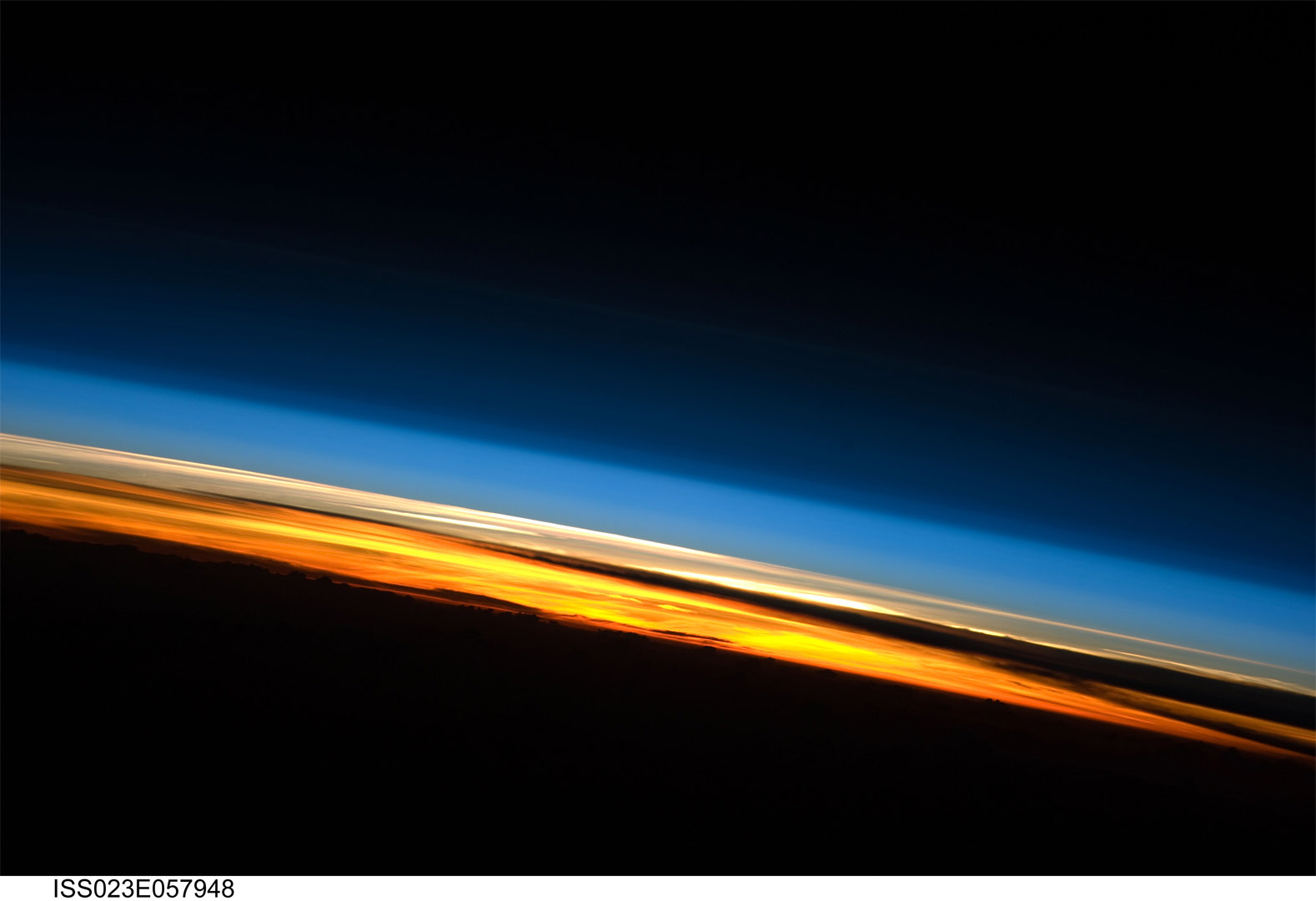
 The setting sun clearly highlights several of the different layers in the Earth’s atmosphere. This photo was taken from the International Space Station.
Prior to the 1900s, most scientists believed that atmospheric temperature would continue to decrease with increasing altitude (see Lesson A2-1 – Math Link). Improvements in balloon and instrument technology, however, surprised scientists by showing that this was not the case. In fact, atmospheric temperature varies considerably at higher altitudes. Scientists today divide the Earth’s atmosphere into several distinct layers based on temperature characteristics.
 Did You Know?
Layered Titan
Scientists have identified Titan, a moon of Saturn, as the only other body in our solar system, apart from the Earth, that possesses a layered atmosphere. Titan possesses a nitrogen-rich atmosphere, just like the Earth’s.
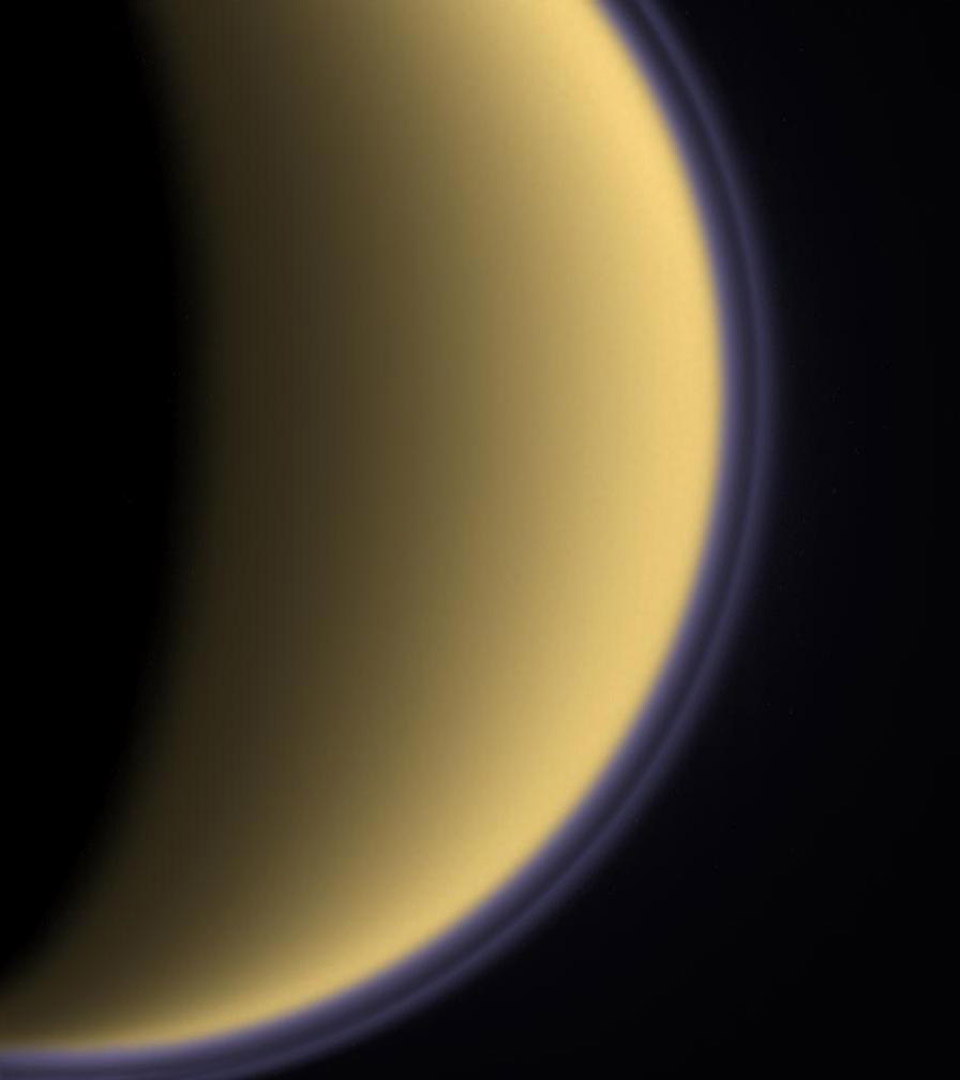 Distinct layers in Titan’s atmosphere are clearly visible in this photo taken by the Cassini Orbiter spacecraft.
Try This!
Distinct layers in Titan’s atmosphere are clearly visible in this photo taken by the Cassini Orbiter spacecraft.
Try This!
Exploring the Layers of the Earth’s Atmosphere
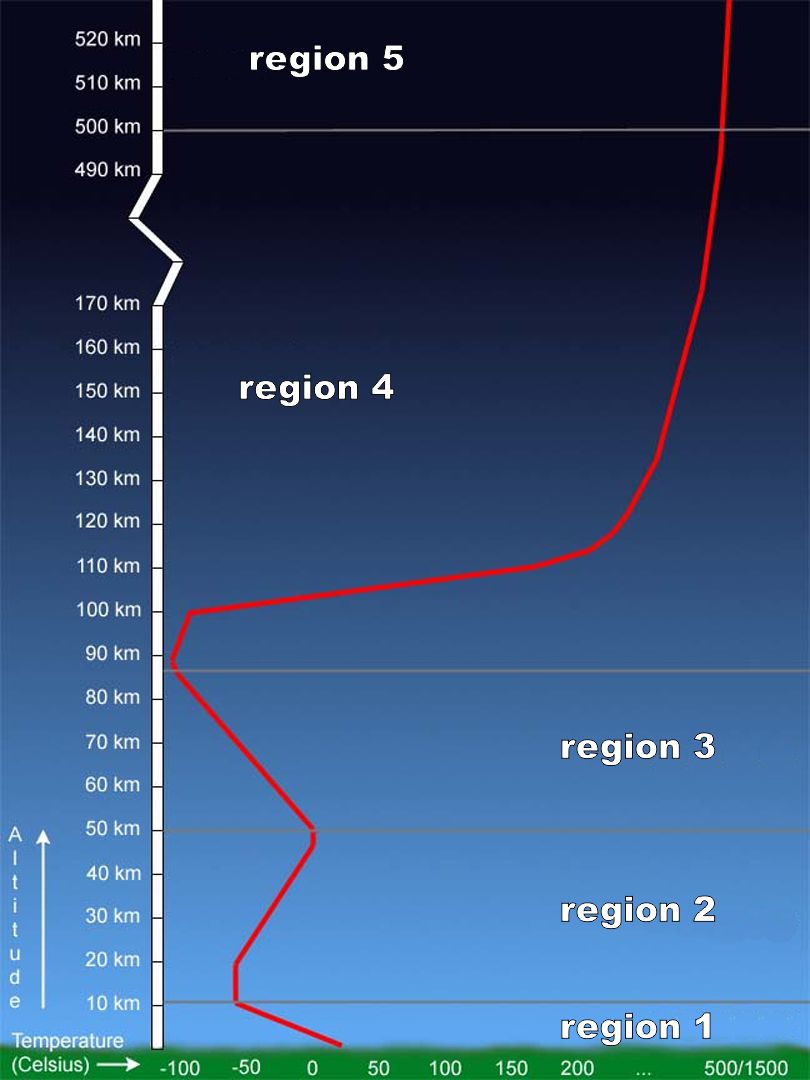 The temperature profile of the atmosphere along with the distinct regions that scientists have identified.
- Click here to zoom in on region 1.
- Use your mouse to click on the region in order to learn its proper name.
- What is the proper name for this region? The proper name for region 1 is the troposphere.
- How thick is the atmosphere in this region? (Hint: Use the temperature profile for this.) The atmosphere is 11 km (6.8 mi) thick in this region. (Thickness = 11 km – 0 km = 11 km)
- Repeat this procedure and determine the proper name and the atmospheric thickness for these regions:
- Click here to zoom in on region 2.
- Click here to zoom in on region 3.
- Click here to zoom in on region 4.
- Click here to zoom in on region 5.
- Complete this data table.
Region Proper Name Thickness (km) # 1 troposphere 11 (i.e. 11 – 0) # 2 stratosphere 39 (i.e. 50 – 11) # 3 mesosphere 37 (i.e. 87 – 50) # 4 thermosphere 413 (i.e. 500 – 87) # 5 exosphere 9,500 (i.e. 10,000 – 500)
- Click here to zoom back in on the lower four levels of the atmosphere.
- How does the thickness of the troposphere, the layer in which we live, compare to the total thickness of the atmosphere up to the top of the thermosphere? Answer this question both qualitatively and quantitatively. The troposphere is only 11 km thick while the atmosphere has a total thickness of 500 km to the top of the thermosphere. The troposphere is thus, a very, very thin shell in our atmosphere. The troposphere is only 2.2% of the total thickness of the atmosphere to the top of the thermosphere. [i.e. (11 km/500 km) × 100% = 2.2%]
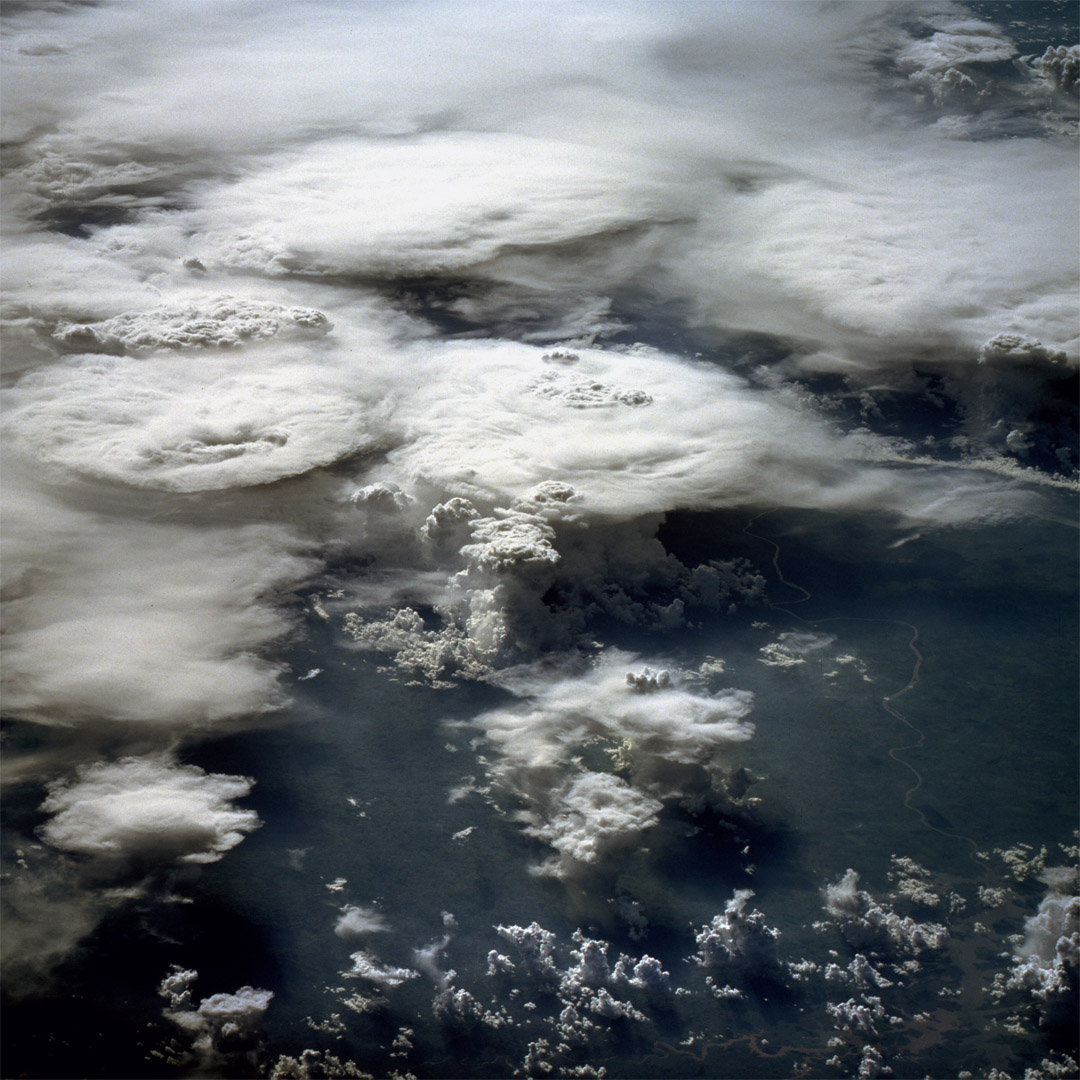 The flat tops of these clouds mark the barrier between the turbulent troposphere and the stable stratosphere.
The troposphere (0–11 km /0–6.8 mi), the layer closest to the Earth’s surface, is the layer in which we live. The Earth’s weather occurs within the troposphere. Approximately 80% of the atmosphere’s mass is contained in the troposphere.
The stratosphere (11–50 km/6.8–31 mi) is a fairly stable atmosphere layer compared to the turbulent troposphere below it. This is the layer in which jet airplanes fly. The temperature in the stratosphere increases because it contains large quantities of ozone (O3) molecules that trap ultraviolet light from the sun. The stratosphere contains 19.9% of the atmosphere’s total mass.
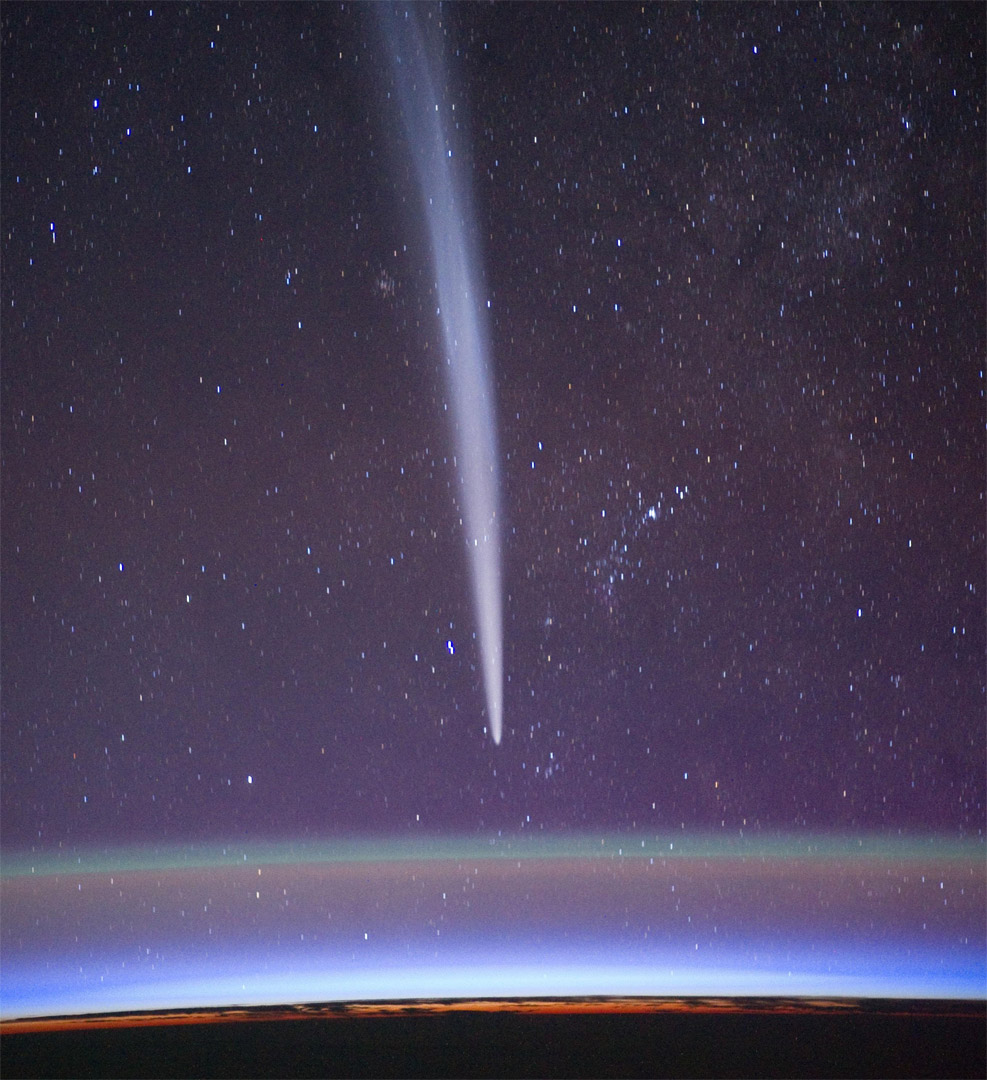 The green band, known as air glow, is in the thermosphere at an altitude of 100 km (62 mi). It is caused by atoms in the upper atmosphere slowly releasing energy that they accumulated during the day. Comet Lovejoy can be seen in the background.
The mesosphere (50–87 km/31–54 mi) is the middle layer in the 5 identified atmospheric layers. The absence of ozone in this layer results in the atmospheric temperature again dropping in the mesosphere. The temperature drops as low as –90°C (–130°F), the lowest temperature in the atmosphere.
The thermosphere (87–500 km/54–310 mi) experiences a temperature rise because oxygen and nitrogen molecules absorb high energy solar radiation. There are so few particles in the thermosphere, however, that the actual heat content of the thermosphere is very, very low. Auroras and the International Space Station (ISS) can be found in this layer.
The exosphere (500–10,000 km/310–6,200 mi) is where the already almost nonexistent atmosphere gradually merges into outer space.
Word Link
(Note: All of these words include the term sphere which is based on the Latin word sphaera meaning ball.)
Troposphere: This word, created in 1909, is based on the Greek word tropos which means to turn. This relates to the vertical mixing, or turning over of air in this layer.
Stratosphere: This word originated in 1909 from the Latin word stratum which means to spread. This is because this region is a stable layer of air when compared to the turbulent layer below it (i.e. the troposphere).
Mesosphere: This word was first used in 1951 and is based on the Greek word mesos which means in the middle. This is because the mesosphere is the middle layer in the 5 identified atmospheric layers.
Thermosphere: This word, created in 1951, is based on the Greek word therme which means heat. This refers to the extremely high temperatures of the very sparse numbers molecules in this region.
Exosphere: This words dates from 1949 and is based on the Greek word exo which means out. This is because the exosphere is the outer layer of the Earth’s atmosphere.