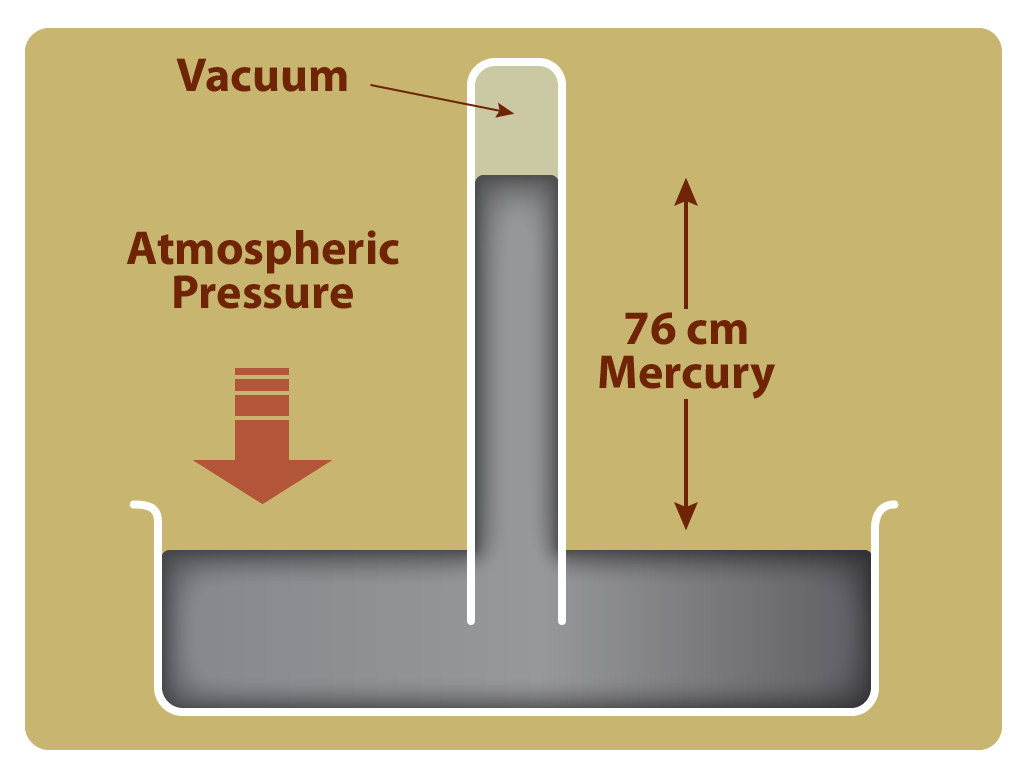
 Torricelli’s mercury barometer.
A device that measures air pressure is known as a barometer. The first barometer was invented by Evangelista Torricelli (1608–1647) in 1643. Torricelli did this by taking a narrow glass tube that was closed at one end and then filling this tube completely with mercury. He then inverted this glass tube into a dish of mercury. The mercury in the glass tube began to flow out into the dish reservoir, but stopped flowing when the mercury column had a height of 76 cm (30 in). Torricelli concluded that the weight of the 76 cm (30 in) column of mercury was exactly balanced by the weight of the air column pushing down on the mercury reservoir. Torricelli also noted that the height of the mercury column varied slightly from day to day. Torricelli concluded (correctly) that this was due to slight variations in atmospheric pressure.
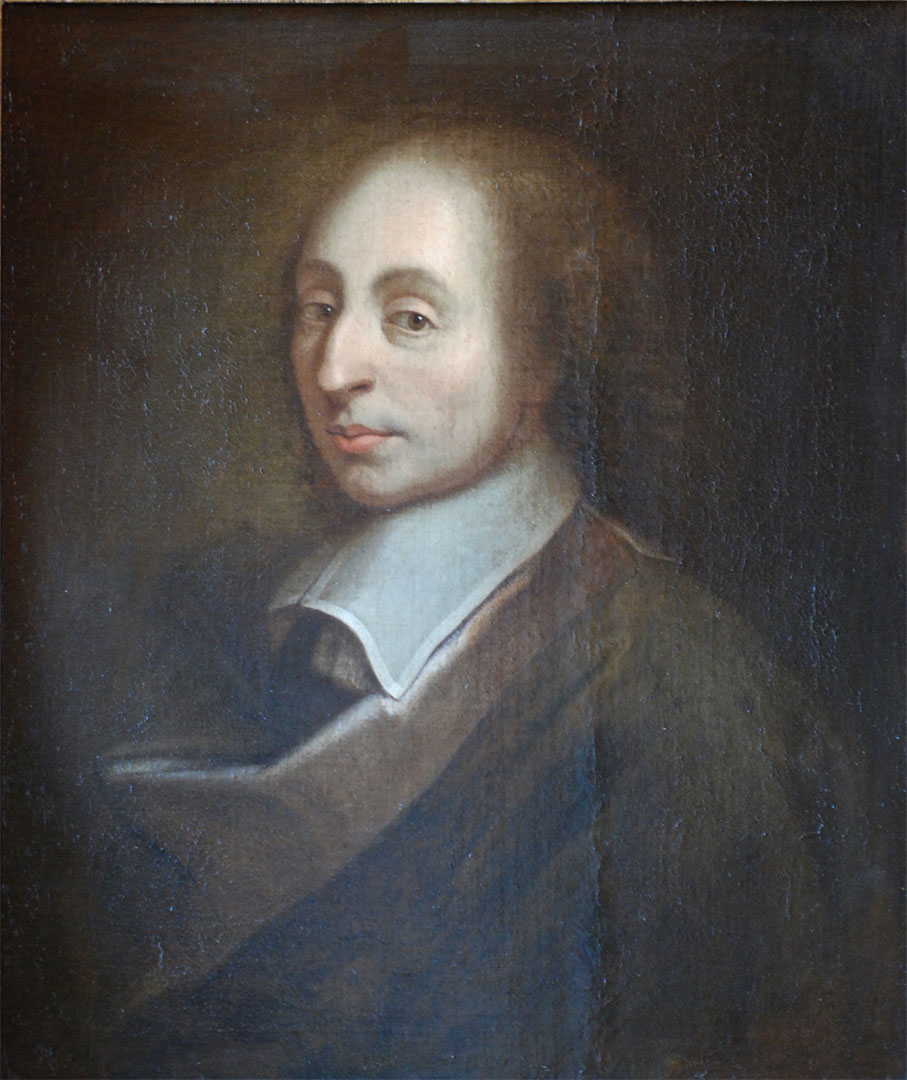 A portrait of Blaise Pascal,circa 1690.
Blaise Pascal (1623–1703) extended Torricelli’s thinking by concluding that if the atmosphere had weight, then that weight should change with altitude since the amount of air decreased with increasing elevation. Pascal tested this hypothesis by having his younger brother-in-law carry two barometers up a local mountain, Puy-de-Dôme. The barometers each measured a drop of 8 cm (3 in) in the height of the mercury column, thus confirming Pascal’s link between altitude and pressure. (Pascal did not do the mountain climbing himself because he was chronically ill and suffered from a number of ailments for much of his life.) These measurements allowed Pascal to calculate that the atmosphere possessed 3.6 × 10¹⁸ kg (8.0 × 10¹⁸ lb) of air. This number is surprisingly close to the currently accepted figure of 5.3 × 10¹⁸ kg (12 × 1018 lb). Pascal’s contributions to the field of pressure were so significant that the SI (metric) unit of pressure, the pascal (Pa), is named in his honor.
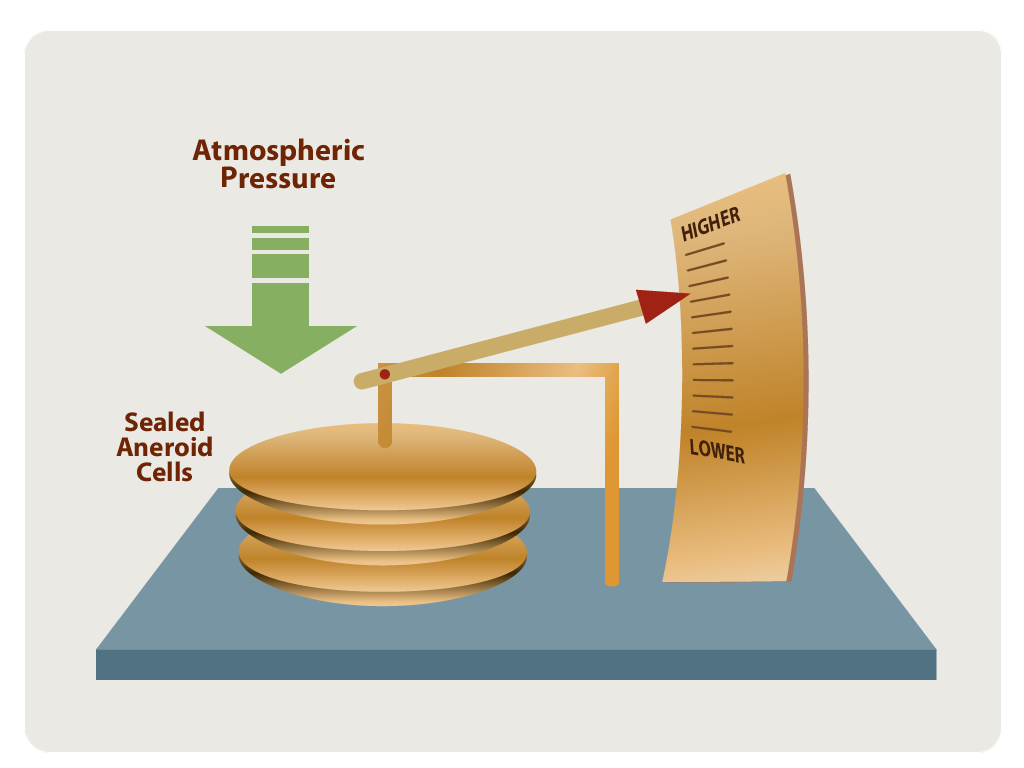 A cutaway view showing the operation of an aneroid barometer.
Although the mercury barometer is still used, the most commonly used barometer today is known as the aneroid barometer. The aneroid barometer consists of a small chamber from which some of the air has been removed. The sides of the container are flexible and bend as the air pressure changes; they bend in with an increase in pressure, and bend out with a decrease in pressure. Inside the chamber a series of levers are connected to a pointer and scale that record these pressure changes.